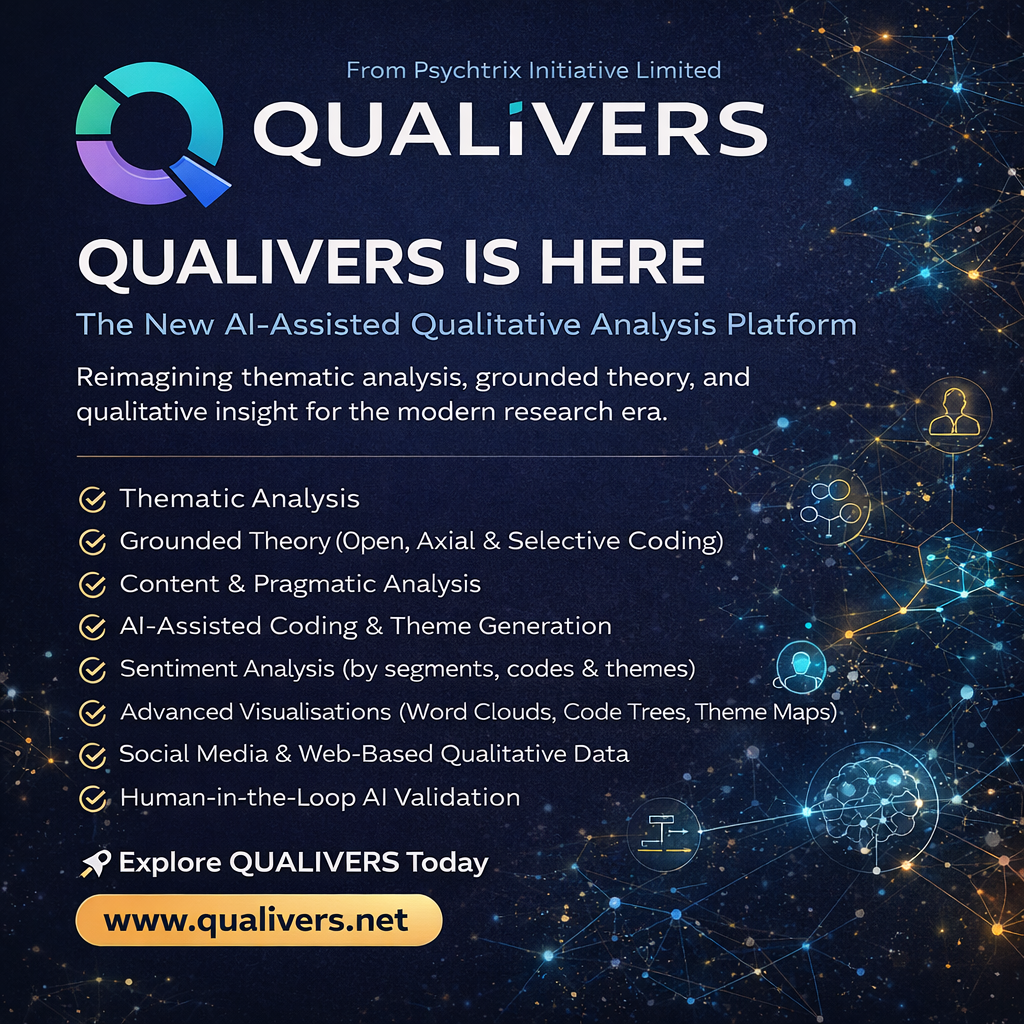
When Enoch O. Oladunmoye, a psychometrician, associate professor, and lead programmer within the Psychtrix Initiative Limited, announced the development of QUALIVERS, one question surfaced repeatedly:
“Why create another qualitative analysis software when tools like NVivo, Atlas.ti, and MAXQDA already exist?”
According to Oladunmoye, the answer lies not in dissatisfaction with earlier tools, but in a fundamental shift in how research itself has changed.
“Qualitative research has outgrown its original tools”
“Most qualitative software was designed for a very different research era,” Oladunmoye explains.
“They were built when datasets were smaller, research was largely offline, collaboration was slower, and AI was not part of the analytical conversation.”
Traditional qualitative analysis software emerged to solve a critical problem of the time: organising and coding textual data efficiently on a single computer. That mission was largely successful. However, Oladunmoye argues that success in the past has quietly become a limitation in the present.
What Was Missing in the Traditional Approach?
According to Oladunmoye, several structural gaps had become increasingly visible:
1. Qualitative Analysis Was Too Manual for Modern Scale
“Manual coding alone is no longer sufficient when researchers are analysing thousands of social media posts, chat transcripts, or longitudinal digital narratives,” he notes.
While manual rigor remains essential, the absence of intelligent analytic assistance has made many projects unnecessarily slow, cognitively exhausting, and methodologically fragmented.
2. AI Was Treated as a Threat, Not a Tool
“Earlier approaches either ignored AI or used it in opaque ways that undermined qualitative credibility,” Oladunmoye says.
What was missing was a human-in-the-loop AI model—one where:
- AI supports pattern detection
- Researchers retain interpretive authority
- Every suggestion is transparent, editable, and auditable
“Qualivers was designed so AI never replaces qualitative thinking—it amplifies it.”
3. Emotion and Sentiment Were Poorly Integrated
In areas such as mental health, public policy, education, and digital discourse, emotional tone is analytically central, not peripheral.
“Most qualitative tools either ignore sentiment or treat it as a shallow add-on,” Oladunmoye explains.
“Yet researchers constantly interpret emotion implicitly—Qualivers simply makes that layer visible, systematic, and reviewable.”
QUALIVERS integrates segment-, code-, and theme-level sentiment analysis, with full human validation.
4. Digital and Social Media Data Were Afterthoughts
“Today’s qualitative data are increasingly born-digital,” he argues.
“But many tools still treat social media text as if it were just another document.”
QUALIVERS was built to natively support digital qualitative realities:
- Social media discourse
- Web-based narratives
- Chat and conversational data
- Longitudinal digital texts
All within an ethical, preprocess-aware pipeline.

5. Analysis Was Locked to One Device
Perhaps one of the strongest motivations behind Qualivers was mobility.
“Insight doesn’t wait for you to return to your office desktop,” Oladunmoye reflects.
“Researchers think, notice patterns, and make connections everywhere—during fieldwork, supervision meetings, conferences, even while teaching.”
QUALIVERS was therefore designed as a fully web-based, cross-device platform, allowing rigorous qualitative analysis on any internet-connected device—desktop, laptop, or tablet.
Why Build Qualivers Now? The AI Moment in Research
Oladunmoye emphasizes that QUALIVERS is not just a response to qualitative software gaps, but to a broader AI turning point in research.
“We are at a moment where AI can genuinely support complex intellectual work—but only if it is designed with epistemology, ethics, and transparency in mind.”
From his psychometric background, he draws a parallel:
“Just as we demand validity, reliability, and transparency in measurement, we must demand the same in AI-assisted qualitative analysis.”
QUALIVERS applies this philosophy by embedding:
- audit trails
- human overrides
- methodological workflows
- interpretive safeguards
A Shift in Thinking, Not Just Software
“Qualivers is not an attack on existing tools,” Oladunmoye clarifies.
“It is a response to a new research reality—one that requires scale, intelligence, collaboration, and mobility without sacrificing rigor.”
In his view, the future of qualitative analysis lies in systems that think with researchers, not systems that merely store codes.

Looking Ahead
QUALIVERS is being positioned not only as software, but as:
- a teaching platform
- a research ecosystem
- a methodological framework
- a bridge between qualitative rigor and AI innovation
“Qualitative research is about meaning,” Oladunmoye concludes.
“Qualivers exists to ensure that meaning is discovered more deeply, more responsibly, and more efficiently in the age of AI.”
🌐 Explore QUALIVERS: www.qualivers.net
QUALIVERS — Built for the realities of modern qualitative research.